BLESSINGS OF 2015

2015,collage-1443181693762.jpg gave me the love and care I had waited to experience with my family.  I was able to show them the love and care I held in my heart for them, by spending time with them

DO NOT WORRY ABOUT TOMORROW
THE UNCERTAINTIES OF TOMORROW 

Graduated from the University of Bradford on 5th December 2014, I faced many uncertainties as I looked to the year 2015. How will I deal with leaving the friends I have made in my time in England? Will I find a job? What would my life be like? What would my friends and family think of me after all these years of schooling and nothing to show? Moreover, how will I explain to them that the man I had been in a relationship with ended it a broadly without an explanation?   These were essential questions, which had no answers at the beginning of the year 2015. These questions did not stop me from knowing God was in control. The first sermon of the year on January 4, focused on reflection of one’s heart and forgiveness of wrongs done to you in 2014. The simple task was for us to write down all the wrongs done in 2014, and lay them before God. When the task finished, I walked home a different person. When the door closed behind me, tears of pain flowed, as I sought to know what I had done wrong in my relationship, which ended 10 months earlier. I had thought I had forgiven him, but it turned out on that Sunday that I had not truly faced my fears. Once I gave that to God, he opened my eyes in a new way.

BLESSINGS
HE IS IN CONTROL

collage-1441775830012He set me free and beside me was a wonderful gentle man who had been a true friend and had wiped my tears on many occasions and listened patiently while I complained. He became one of the first blessings of the year for me. We both confronted our feelings for each other within the few days I had left in England.  Both of us had promised to let the other know how we felt, before we separated and none of us had knowledge of this solemn promise. To confirm God’s leading hand, I visited his parents in France over the summer and we are now waiting to welcome him in my motherland.

On this last day of the year 2015, I just want to thank God for taking away my tears.

Back in Cameroon and so much to do concerning work, I tutored at RFIS for 4 months and gained some teaching experience. Who would have known that God had been preparing me to be a teacher for a while? After my summer vacation, I got a part-time job as an English teacher with College Technique le Bon Berger. God was in control of this year, wiping away my worries of finding a job. I am now looking for a full time job.

Do not worry about tomorrow, for God is in control of it. Your blessings might not come the way you expect them.

I want to thank God for WhatsApp. It has maintained so many of my relationships with friends and kept us in contact. I give glory to the special offer Nextel has for WhatsApp, where I only pay 500 cfa for 7 days unlimited WhatsApp internet. It is a wonderful blessing.

I praise God for good health for my family members in Cameroon, Switzerland, and Kenya and around the world. He has been keen to our distance and has not laid stress on us to attempt to make trips beyond our means. I now look forward to 2016 with an open mind knowing God does not change

A Stranger Among Us

At 1 a.m in the morning of the 23rd December 2015, my mom, sisters and I exchanged our feelings of my stepfather, who would be buried the next day. As I listened to them talk about him, I wondered if there had been something I missed out. This man was kind, loving, and caring. He had been there when my mother needed someone to pay her bills and to give her shelter. To this, I share everyone’s sentiments, and appreciate his kind gesture and love to take us in when my own father rejected us. Yet why am I so defiant towards the thought of owning him as my father?

Sometimes, we seem so sure of something or someone so much that we are convinced that they will never change. Yet life has a way of disappointing us in unexpected ways. When I received the news that my stepfather was dead, I was emotionless. I was void of feelings, until hours later when it hit me that my stepfather was dead. That is when the turmoil inside began. For so long, I thought I knew the man whose name I carry. My memory of the past tells a story of a man, who did not care whether I was fed or not. He seemed to care less whether I was hurting or not and above all, whether I went to school or not. “What do you want money for? Women are trained to cook, raise children and take care of the house. Go and ask your mother for money.” At the age of 9, I felt like my world was collapsing over 1,500 cfa, which was my school fees in class 1 or grade 1. That is when I concluded that this man did not care for me. For many years, I held unto that thought.

As we, four women talked and listened to each other’s feelings, we realized that there was a lot of regret for the better part. My mother saw a man who cared for her and fought against unseen forces that controlled him, thus leading him to neglect those he cared for. As an eyewitness, she testifies to his last few years, where they demonstrated his total control of his mind; revealing the man, he was truly inside. In his last few years, he sought to re-establish the relationship he once had with his children and grandchildren. He was sorry for the things he had done and not done. He had been a difficult man to live with, but he accepted the responsibility for children he did not create. He had taken care of them in his own level and been a man who desired to be good. My mother thus concluded that much of what he did was out of ignorance and at that moment, I truly felt sorry for her and the husband she had lost. My two sisters felt guilty for not reaching out to him sooner. They felt they had neglected him and only reached out to him when it was too late.

What about me? I do acknowledge and respect the fact that he paid my mother’s bride price back and the price on all her children’s head. Like I mentioned earlier, I felt lost in my emotions, as I wondered what my family would think of me. I did not want them to think of me as ungrateful. Yet I could not just fake feelings and accept him as my father. However, I felt guilty that I never knew him and I wished I had given him a chance to know me for the woman I am today. I felt out of place for not being able to claim him as my father. Before I left home, I was shy, timid and a loner. I always felt out of place and found it hard to belong. While sitting with my family and speaking about my stepfather, I felt like a total stranger to them. It has been about sixteen years, which I grew up outside of my own home and tradition. I have been exposed to so many different cultures, which have shaped and built the person I am, and it would be difficult to break away from that knowledge.

Yet, in all of this turmoil, I found something else. I found forgiveness towards the man I thought I knew and acceptance of the man I never knew. If he could live a few more years, I would take the chance to see past the hard man I thought I knew; to the man everyone seemed to know. In all, I was grateful that my heavenly father was there to take care of everything and execute his will in our moment of confusion.

BEING A TEACHER


IMG_0669


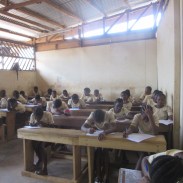
Teachers receive little recognition than they deserve. How many people desire to head to a class of 48 girls, who are rude, impolite and VERY disrespectful and sometimes you find yourself almost at fistfights with them? How many would want to head to a class of 61 students with only 4 girls, and these young men are almost your age and taller than you? Alternatively, how many would want to head to a job without training or orientation, yet are expected to meet all obligations? There are higher figures than stated above, yet there’s a need to pass on knowledge.

Based on the brochure I received with information on the school, I was made to understand that College Technique le Bon Berger (CEBER) worked with street children, orphans, prostitutes, unemployed youths, underprivileged children and others who had dropped out of school. Before we commence on being a teacher, it is good to highlight that I went to CEBER seeking to be a Guidance Counsellor for the students, as well as networking with other partners to help these children get the best out of our social system. Well, that didn’t go as planned. I was asked to teach the students and observe them at the same time. Easier said than done.

Teaching in CEBER is a continuous rewarding experience as well as challenging. It has been a privilege to teach English as a Second Language to Francophone kids. This has enhanced creativity skills, reinforced anger management, boosted management skills and strengthened character development, such as developing a heart of humility towards the students and some authoritative figures.

Challenges

It has been hard teaching Francophone young men and women, who demonstrate their dislike for something very explicitly in verbal, body and facial language. In addition, they speak their native language in class and making comic remarks, thus disrupting the class. This clearly marks their disrespect for the teacher, lack of home upbringing and impoliteness towards their peers. In terms of discipline, they refuse to do what you ask them, and when you send them outside, they begin arguing with you. If you touch them, the others would start chanting “fight, fight, fight”. These are 11-16 year olds.

With such attitudes, one begins to wonder if education is really what some of these children need. This made my neutrality off balance, because as a teacher, I have to administer discipline and as an observer, I am not. The two roles in themselves are constantly conflicting with each other, creating a great gap.

Lack of teaching materials has been another obstacle in teaching these young men and women. Students do not have textbooks, no dictionaries in the library, thus you cannot use the textbook provided. It doesn’t help either, when they do not have the bases in English, yet you are expected to cover the heavy laid out syllabus.

In the past few months, discipline masters have been another challenge towards my authority as a teacher. One halted in the second month, but one persistently carried out his duties during lessons, which undermined my authority as a teacher, thus enabling the students to disregard my authority in the classroom.

It has been hard coming to class sometimes and finding two students, and only to be told that they rest have been asked to clean the chapel. To make matters worse, the other half of the class constantly shows up late for class, because their last period teacher didn’t let them out. At the end of the day, one has to go collecting students all over the campus and by the time class begins, it is 30 minutes or 45 minutes into the period and you have only an hour left to teach. When confronted as to why students constantly come late to class, the teacher says she didn’t hear the bell ring. Do you as a teacher have to depend on the bell or constantly check your watch to make sure you are not going over time? How many power outs do we have in Yaoundé? Does one really have to remind you that there is no electricity?

Observations and responses

The students

Many International Laws have classified the lack of education as one of the factors that enables children to join armed forces. Every country is thus encouraged to focus on the children’s lack of education during rehabilitation and reintegration. “7.78 Educational activities should take into account the children’s lost educational opportunities, their age and stage of development, their experiences with armed forces or armed groups and the potential to promote psychosocial well-being, including a sense of self-worth. Children with disability should be included in educational activities with their peers” (The Paris Principles, 2007)

The past few months suggested that we might be channelling our focus in a wrong direction. Children have been skipping classes, even with the teacher in the class. They would come in, wait for the attendance to be read, and would slip out of the classroom while their friends hand their bags to them through the window. Furthermore, where does one draw the discipline line, especially when certain students purposefully cause havoc in class to be sent out? Some take permission to go out and never return. Students refuse to study for exams, even with the teacher’s efforts to incorporate their theory with action. So far, group work has been introduced in many of the classes, which is meant to help the students interact with their peers who are at the same level in the language. However, some of these students take the opportunity to sleep, which is reflected in their grades at the end of every sequence. They love getting points, but they hate working for those points. Thus, they have realized that group work actually an important part of their studies. In the second sequence, many students in the higher classes got the concept of group work and actually came up with the English words that they had within them. This was very encouraging.

There are some students who appreciate being in a school to study, and there are others who feel like they are forced to study. Being an actor in the field of education as well as an observer does not take long to understand the student’s needs in the cities. Many students have parents who struggle to provide for their needs, but they take it for granted. What is thus missing since they have everything, yet refuse to take education seriously? What is the right action towards these children?

It is easy to say that a child is lazy in the classroom or that they are sleeping in the classroom and not doing their work. After three months of teaching, it is safe to say that these children are struggling with who they are. This is not new, but one cannot generalize all the students without first observing them from their contextual setting. In one of the chaotic lessons with the girls, it was revealed that most of them are from dysfunctional homes with single parents, and some are embarrassed because of their parents’ occupations. Thus, they react in anger or build an attitude, which hides their fears and embarrassment. How can this be confronted? What measures are in place to help these children deal with who they are?

Resources

In terms resources, it has been easier to let the students use the vocabulary they had acquired, to discuss in their groups and teach the lesson. Letting them discuss the question in their groups and crosscheck it with the teacher’s notes has made the class more interactive than asking the students to read in their textbooks, which they do not have. Using pictures as well has been a great way to catch their attention. It had enabled them to describe what they see and finally figured out what the topic for the day is, just by taking a good look at their own descriptions of what they saw. Presentation charts will be used as soon as they are made available. Handouts have been very successful, as they are able to see pictures and construct sentences in the grammar tense being focused on for the day.

Discipline masters

Students have had the habit of coming late for classes and blaming their tardiness on the discipline masters. After observing them for three months and also the Discipline Masters, the matter was taken to the Senior Discipline Master. He thus explained that students are not allowed in classes if they are late, unless they show a Billet D’entrée. Concerning the Discipline Masters, they have no right to enter classes and carry out their duties unless the teacher permits them. No person is supposed to interrupt classes for what so ever reason. The teacher in the classroom has authority over that class. Students are not to leave class until the lesson is over.

Rewards

The Cameroon system measures the students’ good performances through their test results. Cheating is a word well known, and it would be fair to request for a change in the system. Students’ will not study hard, but would expect to pass exams through other’s hard work. A number of students were not too happy with zeros in their second sequence exams, because they used distractions as a means to cheat off each other. It was rewarding after the exams however, when a student refused to look at his marks on 20. When asked why, he was very honest and said the marks were not his to claim. Someone helped him in the exams. Now what am I to do with such an honest student? Why did he decide to reveal that little detail?

Simply because after the scripts had been marked, it was surprising to see that almost the whole class had above average. That should be a good thing right? WRONG. From their class performances, one would expect about 10 students to have an above average. On the contrary, about 4 students had below average out of 38. In class, they were made to understand that cheating would not take them anywhere. If they had cheated during the exams, then it would be shameful for them to rejoice over their score, especially when they know they do not deserve it. Hard work actually enables one to be proud of their work. From that little speech, he came up and spoke the truth, appreciated the speech and he promised to work hard and do his best.

A few days ago some students revealed their desire for someone whom they can confide in. They have faced betrayal of trust in their friends and family members and there hasn’t been no one person in whom they could open up to. This confirmed once more the main purpose and goal as to why I had wanted to work with these students. They are hurting and need someone who can listen as well as meet with their family members, when they are ready to face the problems. It is an emotional journey, and they need a light they can follow.

Although very challenging, getting to know the students and desiring to help them improve in the English language has created a deep affection for them. If sleepless nights are what it takes to get one student to make a choice not to cheat but to work hard, then I shall do my best as their teacher to help him achieve his goals as a bilingual student. Being a teacher is not easy, but is a passion that develops with time, thus making every obstacle a great weapon.

Another encouraging reward has been the Pedagogic: Capacity Building workshop training we undertook in November. It coincided with the basic knowledge of transforming student’s knowledge into action, which is one of the objectives of Human resource departments. The focus was on developing creative and innovative students, rather than pumping them with theory. The teachers were encouraged to device activities, which created opportunities for students to be creative. For teachers to achieve that, they themselves were encouraged to be spontaneous, innovative and open-minded.