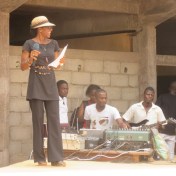
In CEBER
Working with children and young people is hard and demanding no matter how skilled you are with them. Children and young people all come from different backgrounds with different upbringings and cannot necessarily be categorized as one. Due to their different backgrounds, ironically, they bring out the worse in you as well as the best. Sometimes, they push you to the edge, drawing you into a battle field. Teaching in the last five and half months in College Technique le Bon Berger (CEBER), has been both a rewarding experience and a challenging one. One of the challenges faced was with indiscipline students disrespecting authority. Secondly, lack of materials made it hard for students to participate. In addition, discipline masters and the administration were a great obstacle in carrying out their duties. Other teachers as well, had no respect for one’s time, thus they would hold students in class and continue with their lessons. It is not a laughing matter, when class begins and it is well into 20 minutes that you find students walking into your class, or you have to go and look for them.
Measures to combat challenges
Assigning seats: This keeps control of the class, because students are separated from friends who often time, influence them to converse in class. Although, most teachers outside of Africa would agree that this should have been done from the beginning of class, it would be better to view things from the context we found ourselves in. Assigning seats is considered a lot of work for most teachers and the administration.Therefore, it is often left to the teachers to direct their classes as they see fit. I went into teaching with a clueless mind as to what to do with notorious students, especially, when there are no clear defined rules and regulations for discipline. Thus, I have been pushed to adopt certain methods not exercised in CEBER. To the students and staff, this is a foreign method, yet has proven effective, because the most notorious class has been sobered through this measure. They sit in their seats when they walk into class, with the knowledge that if they move from their seats, they would be sent out of the class and marked absent. To this, they are less inclined to speak with their friends and discuss unrelated subjects in class. It sounds like dictatorship, but the notion here is not whether they are prisoners or not, but whether they are grasping the concepts and being able to practice them in their daily life. Learning without practical use is meaningless.
Keeping notes on indiscipline students: Normally, a student gets three warnings from the teacher concerning their comportment in class. They are often asked to see the teacher after class, where they are counselled. If they continue with the same conduct, then their names go into a form from the administration, which would result into the summoning of their parents. One of such meetings will take place on 20th February 2016, where students will be summoned with their parents to discuss their conducts in school. So far, some of the notorious students have relented.
Group work: Group work has been effective combating the lack of teaching materials. Summarizing the lesson into a group activity enables students to have access to the work before them. They can thus discuss the work while reading the words over and over, and being able to ask questions because they can see the paper. To accomplish this, I constantly, type up the lessons into a page and photocopy the page for the students. Learning a language improves when a person can see before them and relate to what the teacher is talking about, rather than just listening to words go into one ear and out the other.
Oral conversations: The students have three hours of class every week. They have two hours one day and one hour another day. To improve and boost their esteem in oral conversation, I have decided to use the one hour as a practical class for them. Together they will converse and not be scared of what others would think.
Staff General Meeting: Concerning the challenges with authority and staff, the Principal addressed these issues in the staff general meeting. He also highlighted that there would be consequences for not fulfilling one’s duties and responsibilities in the appropriate way. This was a constructivestep both to the administration and the school as a whole, because not only do they seek to improve the students, but also the employees as well.
These measures have improved the class situation tremendously, and has encouraged not just me, but the students as well. When they see me outside of class, they try to converse in English. Gradually, they are asking questions in class and demanding for worksheets which are meant to increase their understanding skills. Thus, I have been urged to respond to their needs once again with more enthusiasm.
Other observations
The need to be heard: In the past two months, I have also had the opportunity to talk with students and just listen to their home situations. My hypothesis from the first part of Being a Teacher, was further proven to be true to a certain extend. Students live with relatives who consider them as no bodies. These young people are treated no less than street children, hence they build a defence mechanism. Through the pain and maltreatment from the adults in their lives, they classify all other adults under the same category. I have been able to loosen my high held opinion of their conduct.Although, some have no such defence mechanisms, they look to you as an ideal adult in their life who cares. This is reflected in their written essays, as they pour their hearts and minds. Some do have loving parents, but the company they keep coax them to act out. Others on the other hand, are plain spoilt brats that need serious discipline. They believe they can say anything and get away with it because they parents are wealthy. Well, that can be done in any other class, but mine.
Earlier in the new semester, a student was sleeping in my class. When I touched him to wake him up, he got so angry and told me never to touch him. I was quite irritated by this, because he has no right to talk to a teacher like that nor to sleep in class. His next words made me guilty, for he said “you don’t know what is going on at home, so don’t talk to me like you know me”. True, that I don’t know what goes on at home, but as a student, he still had no right to talk to me like that. I told him to get out of my class. However, the next class, I told him, I would like to speak with him. So far, I have not seen him since that class. They need to be heard.
In addition, some of these students don’t speak at home, so when they are in school, they use the opportunity to speak and express themselves. The challenge right now is to help them know when to express themselves, and not during lessons.
Fear of torment: These students are afraid to speak out in fear of being treated worse than before. In their own way, they withdraw from the family setting and hide in their rooms or find comfort in friends. Some prefer to eat outside with friends than eat at home, where their worth is not appreciated. When asked if they would like a visit to their home for observation, they say no, because they would not want to be beaten afterwards. They would rather play the good/bad child, than to be blamed for bringing trouble on the family. It is really painful to listen to their pain. When they see you, they are so happy. Sometimes a hug is all that they need to brighten their day or to have someone who loves and cares for them.
In all, I am learning a lot about teaching, reaching out to the students and praying for them even when I am exhausted from screaming at them. Seeing their smiles and teasing when I walk into class always warms my heart and boosts my energy.
 Goody'Nglish